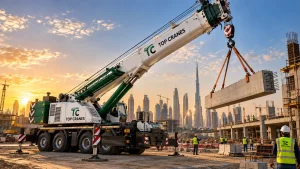
A mobile crane booking can look straightforward: identify the load, agree on a date and arrange delivery. But the lift depends on access, ground support, crew coordination and sufficient capacity at the required reach.
Consider a contractor preparing to install a rooftop air-conditioning unit in Dubai. The unit’s weight may be known, but the nearest safe crane position could be farther from the building than expected. A crane selected only by its advertised tonnage might then be unsuitable. Rescheduling can disrupt several teams.
This is why mobile crane rental in Dubai should begin with a practical pre-hire assessment rather than a price enquiry alone. The following 12 checks help contractors, site engineers, procurement teams and project managers ask better questions, compare realistic quotations and avoid preventable delays. They apply across UAE construction and industrial projects; competent professionals must still assess each lift.
1. Confirm the real weight and dimensions of the load
Start with reliable information about the object to be lifted. A delivery note or approximate estimate is not always sufficient. Obtain the manufacturer’s weight, a verified shipping or fabrication record, or another dependable measurement. Record the object’s length, width and height, its lifting points and any uneven weight distribution.
The crane must handle the total suspended load, not just the principal item. Rigging, slings, shackles, spreader beams, hooks or lifting attachments may contribute to the weight considered in planning and capacity checks. A lift planner should check which weights the manufacturer’s chart already includes.
For large machinery or prefabricated units, identify the centre of gravity and approved lifting points. If these details are missing, resolve them before selecting equipment. An uncertain load weight creates uncertainty in every later calculation.
Before requesting a quote: Send a load drawing or specification, verified weight, dimensions and photographs showing the lifting points.
2. Measure the lifting radius at pickup and placement
One of the most common crane-hire misunderstandings concerns nominal capacity. A machine advertised as a 100-tonne crane cannot necessarily lift 100 tonnes at the radius required by a particular site. Actual permitted loads vary with the crane model, boom configuration, support arrangement and the manufacturer’s load chart.
The working radius is the horizontal distance from the crane’s centre of rotation to the load’s centre of gravity. Check the radius when the load is picked up and when it is placed; the most demanding point of the lift may occur in between. Account for building setbacks, barriers and positions where the crane cannot safely stand.
Changing the setup position can change the lifting requirement. Provide a marked site plan or measured sketch and ask a competent planner to validate the proposed configuration against the relevant chart.
Before requesting a quote: Supply pickup and landing positions, proposed crane location and approximate horizontal distances.
3. Check hook height, boom clearance and the lifting path
Lifting height is not simply the height of a building. The hook must have sufficient clearance for the load, rigging arrangement and any obstacle along its path. A rooftop installation, for example, may need extra height to raise equipment over a parapet before it can be lowered into position.
Identify nearby structures, scaffolding, overhead services, temporary works and other restricted areas. Note whether a load must travel above an existing roof, beside a façade or through a narrow opening. The boom itself must also have enough clearance throughout the planned movement.
The lift planner will consider the load path, hook height, boom length and operating geometry together. A better setup position may avoid the need for a larger crane.
Before requesting a quote: Share elevation drawings, obstruction heights, photographs and the intended final position of the load.
4. Select a crane type that suits the job and the site
There is no single mobile crane configuration that is best for every UAE project. Truck-mounted mobile cranes can be suitable where road access and an efficient setup are important. All-terrain cranes combine road travel capabilities with mobility on appropriate site surfaces. Rough-terrain cranes are built for movement around certain uneven construction sites, although they may require separate transport between locations.
Crawler cranes use tracks and may suit substantial or longer-duration lifts, but often involve more complex transport, assembly and ground preparation. Suitability depends on the full project.
The correct choice balances lifting radius, capacity, access, terrain, mobilisation and duration. Do not assume that a machine able to travel over rough ground can safely lift on unassessed soil, or that road mobility eliminates the need for delivery planning.
Before requesting a quote: Describe the terrain, site access, number of lifts and expected working period; ask for a justified equipment recommendation.
5. Confirm that the crane can enter, turn and set up
A crane reaching the site gate does not guarantee that it can reach a safe operating position. Check gate width and height, internal road widths, turning areas, ramps, gradients, overhead pipes and temporary obstructions. Larger cranes may need additional space for counterweights, boom configuration and support equipment.
The setup footprint matters just as much as the vehicle footprint. Outriggers can extend beyond the chassis, while a safe lifting area may require barriers and a separate route for pedestrians and other machines. Identify locations where deliveries or site traffic would conflict with the lift.
A useful approach is to mark a proposed crane position on a site plan and walk the route with the site team. Arrange a survey where access is uncertain.
Before requesting a quote: Provide gate measurements, route photographs, site drawings and any restrictions on crane positioning.
6. Verify ground-bearing capacity and outrigger support
A mobile crane transfers substantial forces into the surface beneath its supports. A yard that carries delivery lorries may not necessarily support concentrated crane outrigger loads. Loose fill, recently backfilled trenches, underground services, buried chambers and poorly compacted ground all deserve attention.
The lifting plan should consider ground conditions, the crane’s anticipated support reactions and suitable mats or other load-spreading measures. Support arrangements must be determined by competent people using the equipment manufacturer’s information and site-specific ground data. Never choose mat sizes by guesswork.
Ground can change after excavation, rain or heavy traffic, so reassess conditions before lifting.
Before requesting a quote: Disclose recent excavations, underground utilities, surface construction and any available geotechnical information.
7. Identify permits, road restrictions and site approvals early
Administrative delays can prevent an otherwise prepared crane from reaching the project. Requirements depend on the work location, relevant authority, equipment movement, road use and whether public access or traffic must be affected. Do not assume that the same permissions apply to every Dubai site or across all Emirates.
In Dubai, the Roads and Transport Authority has a permit process for eligible heavy-vehicle movements on restricted roads or during restricted periods. Updated truck movement restrictions took effect on 1 October 2026, making route planning particularly important for deliveries that may be affected. Separate approvals may be necessary for road occupation, traffic management or particular construction activities, depending on the situation.
Agree who handles applications and allow time for approval.
Before requesting a quote: Share the exact project area, planned working hours, proposed transport route and any known access restrictions.
8. Verify crane inspections, documents and personnel competence
Equipment availability should never be the only condition for confirming a rental. Check the required inspection and testing documentation for the proposed crane and lifting accessories. Confirm that operators, riggers, signallers and supervisors hold qualifications or certifications appropriate to the work and the applicable authority.
For construction sites under the Dubai Development Authority’s jurisdiction, Circular 614, dated 14 March 2025, specifies inspection and certification of lifting equipment by EIAC-accredited companies, certification of relevant lifting personnel through EIAC-accredited personnel certification bodies, and maintenance records kept on-site. Other jurisdictions may apply different specific requirements.
Abu Dhabi’s Code of Practice 34.0, Version 4.1 (2026) also addresses lifting plans, equipment suitability, personnel competence, inspection and maintenance within its jurisdiction. Verify documentation before mobilisation.
Before requesting a quote: Ask which certifications, inspection records, operator documents and project-specific approvals will be supplied.
9. Agree on the lifting plan, rigging and communication
Even a properly selected crane can be unsafe when the lift itself is poorly coordinated. A competent person should develop a plan proportionate to the complexity of the operation, supported by a risk assessment and appropriate method statement. The plan should describe the lifting sequence, equipment configuration, load path, personnel responsibilities, exclusion zone and conditions under which the lift must stop.
Check the rigging arrangement, including suitable lifting points and correctly rated slings, shackles or spreader beams. Establish who will attach the load, who will direct the operator and what signals or radio procedures will be used. If the operator loses the agreed communication, the operation should stop until communication is safely restored.
Complex or unusual lifts need a more detailed assessment than routine handling. Agree on one procedure understood by everyone.
Before requesting a quote: Explain whether the lift is routine or unusual and clarify who will supply the lifting plan, rigging and supervising personnel.
10. Plan for weather, visibility and changing site conditions
Dubai projects operate in an environment where wind, heat, dust and reduced visibility can affect lifting arrangements. Wind is especially relevant for large panels, cladding, prefabricated components and loads with a broad surface area. A relatively light object can still present difficult handling characteristics when exposed to wind.
Do not rely on a single universal wind-speed limit. The acceptable operating conditions depend on the crane, load, configuration, manufacturer’s instructions and project-specific risk assessment. The lifting team should have a process for monitoring conditions and stopping work when limits or safe visibility are compromised.
Recheck the site before lifting: other trades may introduce obstructions or enter exclusion zones.
Before requesting a quote: Identify exposed locations, unusual load shapes, shift hours and any known environmental restrictions.
11. Coordinate mobilisation, deliveries and the lifting window
The crane is only one part of the operation. A heavy item may arrive on a flatbed or lowbed trailer, require an unloading area and then need a prepared installation crew to receive it. If the trailer arrives late or the installation team is unavailable, paid crane time may be lost.
Create a sequence covering arrival, access clearance, setup, checks, rigging, lifting, final placement and demobilisation. Confirm who controls the site gate, who releases the load from transport, who inspects its lifting points and who authorises the final placement area. Plan for realistic setup and breakdown time rather than treating all booked hours as lifting hours.
Across the UAE, longer journeys also require realistic mobilisation time and one site contact.
Before requesting a quote: Give the required date, site contact, delivery timetable, receiving crew details and realistic operating window.
12. Compare the complete rental quotation, not just the daily rate
A low headline price does not necessarily mean a lower project cost. Crane rental prices in Dubai vary with equipment type, capacity, rental duration, site requirements and services included. Two quotations can appear similar while covering very different obligations.
Request a clear breakdown of mobilisation and return transport, minimum hire hours, operator provision, rigging personnel, lifting accessories, fuel, standby time, overtime and any applicable permit or setup costs. Clarify who is responsible for ground preparation, additional mats, access arrangements and delays caused by changes to the project.
Also check what happens if the lift is postponed, the load specifications change or the equipment needs to remain for longer than expected. Compare the full agreed scope, not a headline rate.
Before requesting a quote: Ask for a written, itemised proposal stating inclusions, exclusions, responsibilities and conditions for schedule changes.
A simple pre-hire handover that prevents repeated questions
Most rental enquiries move faster when the contractor prepares one information pack instead of sending details in separate messages. It need not be complicated: a site plan showing the proposed crane position, a load drawing or photograph, confirmed weights and dimensions, pickup and placement points, approximate working radius, required height, ground information and the intended date will provide a useful starting point.
Include photographs of entrances and the operating area, information about underground services, and any site rules or permit requirements already known. Note what remains unverified. The purpose is not to replace a professional lift study; it is to make the first technical discussion more accurate and to expose missing information while there is still time to resolve it.
Share revised details immediately: changes to the load or lifting route require reassessment.
Frequently asked questions about mobile crane hire in Dubai
Can I choose a mobile crane using load weight alone?
No. A crane’s rated maximum capacity does not describe what it can lift at every radius. The lift planner must assess the actual load, working radius, boom configuration, support conditions and manufacturer’s load chart.
Is a site visit always necessary before crane rental?
Not for every straightforward enquiry, but uncertain access, ground conditions, obstructions or complex lifting geometry may justify a competent site survey. Clear drawings and photographs help identify when additional assessment is needed.
Who should prepare the lifting plan?
The responsible organisation and a competent lifting professional must establish the plan in accordance with the applicable site and authority requirements. Rental arrangements should clearly allocate planning, supervision and execution responsibilities rather than assuming the other party will handle them.
How can contractors reduce unnecessary crane standby charges?
Confirm that the load, transport, lifting crew, site access, approvals and receiving team are ready for the same agreed window. Ask in advance how the quotation treats waiting time, overtime, cancellations and rescheduling.
Conclusion: good crane rental starts before the crane arrives
Hiring a movable crane is not simply an equipment transaction. It is a coordinated operation involving load data, lifting geometry, ground support, competent people, transport, site readiness and clear commercial terms. The most useful pre-hire checklist is one that reveals uncertainty early enough to act on it.
For contractors working in Dubai and across the UAE, these 12 checks turn a broad rental enquiry into a clearer technical brief. They cannot remove every project risk, but they can reduce avoidable misunderstandings and help the site team make informed decisions about equipment and scheduling.
How Top Cranes can help with mobile crane rental in Dubai and the UAE
For projects that need reliable mobile crane rental in Dubai or heavy machinery hire elsewhere in the UAE, Top Cranes provides crane rental, lifting operations, transport and logistics support, site assistance and project consultation. Its team can review the load, access conditions, intended lifting schedule and equipment requirements to help identify a suitable rental approach, supported by maintained machinery and certified operators. Share your site details, load specifications, proposed dates and any transport requirements to discuss the next steps and request a project-specific quotation from Top Cranes.